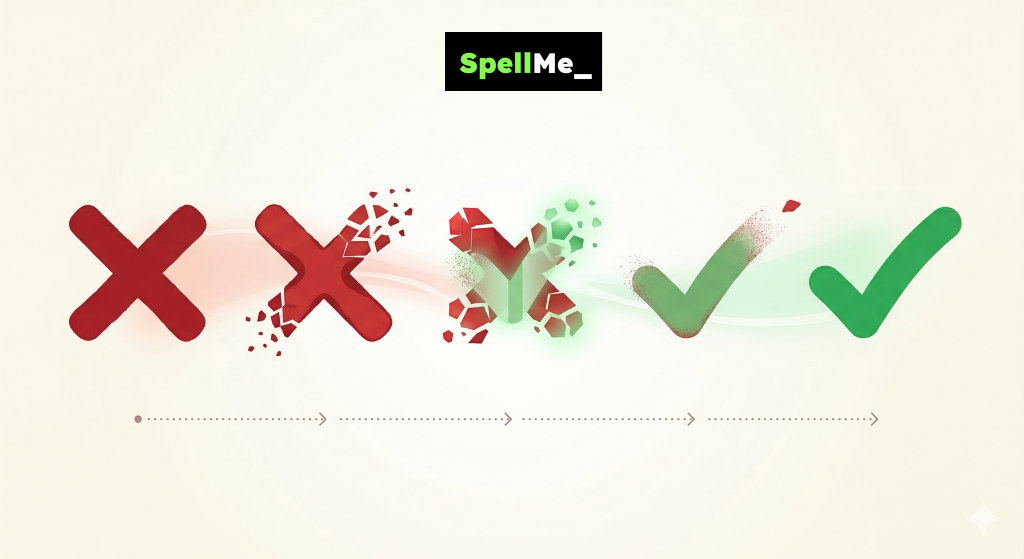
Modern EdTech Struggles with "Wrong" Answers
The most successful people in the world don't just tolerate failure; they utilize it. Silicon Valley work ethic is built on the idea of 'failing forward,' a concept where every error is a stepping stone to success. This is how SpellMe works, and why it works so well. Unfortunately, there are not many edtech tools like this. Many tools currently in our classrooms haven't caught up to the fail forward philosophy. By sticking to binary 'right or wrong' models, they are missing the most important part of the learning process: the feedback loop that happens immediately after a mistake is made. Good teachers know how to use mistakes as learning opportunities. But, in our rush to digitize the classroom, we have built systems where failure is a dead end rather than a step to success. This needs to change. Let’s take a deeper look at what is actually happening and why failing is so important to the learning process.
The Science of Why We Need Failure to Succeed
Mistakes help create accurate mental models. Cognitive psychology tells us that mistakes are important to the learning process because the mistake becomes a trigger for our brain to ask questions about the problem, and starts a process of reflection. ‘What did we do wrong? Why did that happen? How do we fix it? These internal questions, in the presence of our practical experience of making that mistake, are powerful tools in problem solving.
We Need to be Comfortable Enough to Make Mistakes
In order for all this to work, students need to be in an environment that nurtures their learning, allowing them to succeed through their failure without penalising them. There has to be emotional and motivational support. The alternative, which we too often see is the learning potential is shut down when an incorrect answer is given. Instead of guided questioning to find out the student’s thought process and correct it, a teacher gives the correct answer or moves to a student to do so. Leaving the other student embarrassed and sometimes still confused as to why they were wrong. A good teacher (which many teachers are), would know how to manage this in the correct way. Unfortunately, our edtech is not helping us enough. Check out part 3 of my article on ‘Reading isn’t natural’ to read about how this negativity can change the mind from an open learning mode to a closed protective mode.
How Current Edtech Handles Wrong Answers
The current edtech landscape is lacking on how it handles failure. And AI doesn’t seem to be making things any better. Most edtech tools, for maths, spelling, literacy and other subjects allow only binary answers. Students get it right, get points and move on, or students get it wrong, lose points and move on. Sometimes there is an explanation and sometimes not. There is rarely an opportunity for another chance at a question answered incorrectly, or any scaffolding support, and even more rare is the reward for the whole process.
Take IXL for example, which I think is a great edtech tool for maths and literacy (not so much for social studies and science, but that is a discussion for another day). I have used this tool many times for tutoring students and young family members, and witnessed tears, frustration and annoyance at the user experience of how it handles a student’s wrong answer. In a non-edtech environment (face to face with a good tutor), if a student got a question wrong, that tutor would never just give the student the correct answer and move on. They would first give hints, steer the student towards the correct answer, scaffolding the learning. They would try their best to get the student to come up with the answer themselves. With IXL, it is a simple binary. Right or wrong. Although IXL does give an explanation for a wrong answer, allowing the student to reflect on their mistake, by this point it is too late for the student to readjust, to try that same question again like a real life person would. IXL is not the only culprit here, many spelling apps act the same. So what should they do instead?
How EdTech Can Manage Failure Through Superior Feedback
- Lower the stakes for learning: At the very least, these tools should shift to low-stakes questions, where platforms reward attempts as well as correct answers. The rewards don’t have to be as high as the correct answer.
- Give feedback before marking: They can also provide corrective, actionable dialogue instead of just marking the answer wrong.
- Give more chances: They can allow resubmission, allowing the student an opportunity to fix their mistake.
- Give guided personal feedback: They can use intelligent feedback systems that can understand the student’s mistake, possibly based on previous errors and give guided, directed feedback and hints.
All of these features are in SpellMe. 1. XP isn’t removed for incorrect answers. In fact students get rewarded a few XP for every wrong attempt, because each wrong attempt leads them closer to the correct answer. 2. When students make mistakes immediate feedback is given hinting at the correct answer. 3. Students are given unlimited opportunity to get the correct answer to each question, instead of moving on. And final 4. Intelligent feedback based on previous mistakes is available to them.
All of these help build an environment that not only makes it ok to make mistakes, but turns the mistake into a learning opportunity.
The student perspective
I once asked a student:
‘Why do you get upset when you get a question wrong in IXL, but you don’t get upset when you use SpellMe’?
After a short thinking pause, they answered
‘I don’t know… I think it is because in IXL when I get a question wrong, the points go down and I can’t try the question again. That makes me feel sad. But in SpellMe, the points don’t go down and I can try again till I get it right, so it’s ok.’
The student was 8 years old, and was most likely neurodivergent, so didn’t handle disappointment well. This made things more difficult. That disappointment from the negative feedback often led to a mental switching off, and an unwillingness to learn in that moment. This is often a defense mechanism that struggling students employ to protect themselves from negative feelings of failure. Not every student would experience failure in that same way, but every student would benefit from improved failure handling in these situations.
This environment helps students realise that mistakes are normal. It is how we learn, so we should let our mistakes teach us. It helps students love challenges and view mistakes as stepping stones to success, and not something to be punished for. When looking for your next Edtech app, make sure it handles failure in the right way.