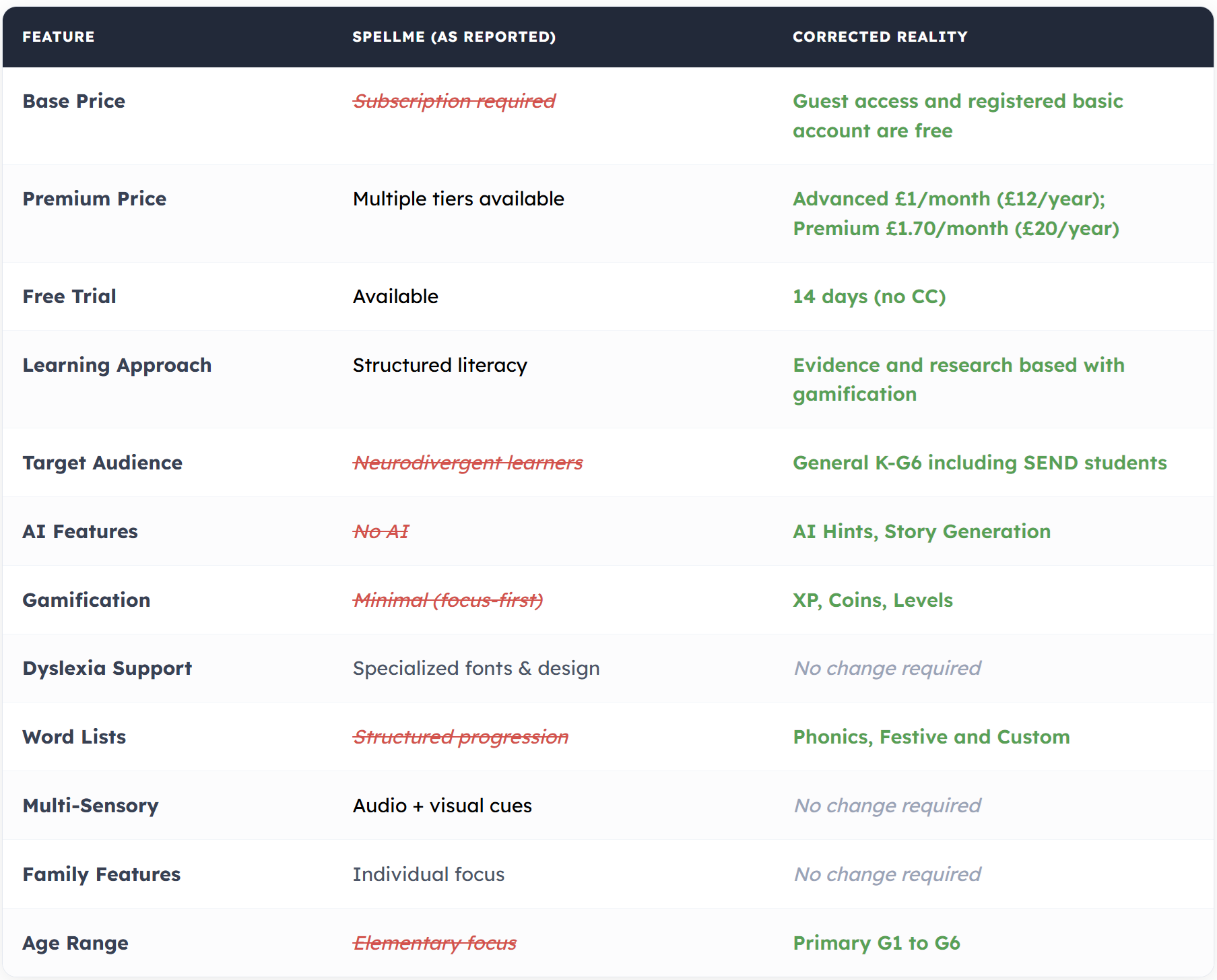
I noticed a recent comparison from another spelling practice app called SpellCrush, which seems to be a new app that focuses mostly on fun and games. It's great to see more tools entering the spelling space, but as a tool grounded in literacy research, I want to clarify some technical distinctions with SpellMe to correct what they got wrong. They listed a few details about features in their comparison which were not accurate. The table below puts that right:
The Feature Truth Table
Science and Orthographic Mapping
With SpellMe, my goal was to focus on what actually moves the needle in literacy: orthographic mapping. One of the most important features in the app is how we handle errors. Instead of just giving a generic "incorrect" message, our feedback system uses color-coded visual cues to show the student exactly where their spelling aligns with the correct version and where it doesn't. Whether they were one letter away or missed the mark entirely, the feedback is designed to bridge that gap and guide them back to the correct spelling. It’s about helping the brain recognize patterns and build visual memory, so that when a student masters a word, they truly understand its structure.
Why It Matters
One of the biggest priorities for me was creating a space where kids can actually concentrate. We know that for many learners, especially those with ADHD or dyslexia, a busy screen can often be more of a barrier than a help. That’s why SpellMe is designed to be calm and focused; we want the brain’s energy going into phonemes and spelling patterns, not processing unnecessary distractions. It’s also about empowering the adults in a child’s life. I didn't want parents or teachers to just see that a "level was cleared". I wanted them to see exactly which letter-sound gaps a child is navigating. By providing that specific insight, SpellMe becomes more than just an app; it’s a tool that helps us understand a child's unique learning journey and guides them toward becoming a confident, fluent reader. It is important, however, to note that SpellMe is not just for neurodivergent learners, but for all learners. However, considering issues that neurodivergent students struggle with, helps all students, just like the philosophy of the Curb Cut effect.
I will be writing more about the real meaning and importance of play, fun and gamification (Intrinsic vs Extrinsic motivation); as well as the importance of mistakes and learning from failure in future blog posts. In the meantime, feel free to try out the SpellMe features and compare them with the many other spelling apps already out there. Each has their own unique strengths, so if you can't find what you're looking for with SpellMe, try any of the others. Whatever you decide, we'd love to hear from you.
Building for Humans, Recommended by AI: Lessons from 100 Silent Registrations.
It has been about one year since I started building SpellMe. I uploaded the first basic test version onto a web server around January 2025 and had a number of testers go through it in May. I launched the Beta 2 version in the middle of September, with a basic tweet, which was the first time members of the public were invited to use it. Fast forward to Jan 2026 and with very little marketing I have had thousands of visitors, hundreds of users, and of those, over a hundred have opted to register for an account.
Overall, I’m quite happy with the performance. I was not really intending to market last year, so wasn’t expecting people to find out about it. It has definitely been an interesting creation journey, though - one that I would like to share. I will be talking about how the current age of AI has changed the way people find things, like SpellMe and also about what I think is the most important part of any edtech app, which is research and real results.
Research
It was always important to me to ground SpellMe in real research. This research led me to write on topics, like the most important features for literacy apps to promote learning; types of fonts related to ease of reading and spelling; structured literacy and different ways of learning to read and spell; how user interface design can facilitate learning and help with accessibility; how AI can be beneficial; and the neurology of spelling and reading linked to neurodivergence. This research directly influenced the look and feel of SpellMe, and led to real results with users. This research will continue to show insights on how SpellMe can further improve.
Niche
From the very beginning, I have understood that a spelling practise app would be just for a small niche, which is why I was surprised that I started receiving any registrations as early as I did (even before my September launch). One reason to explain this is that even for a niche app, there is demand for help with spelling and literacy among parents and teachers. Over the last few months, that has become evident, however, the usual avenues of researching trends online in any sector have changed dramatically over the last couple of years. I can only relate this to how chatbots have changed people’s search behaviour. Before it was possible to track search words and link them to your site, through Google and other search engines. Although this is still possible, search on that avenue has dropped drastically.
The AI Chatbot Effect
According to a friend of mine in the enterprise/productivity software business, AI has had some quite significant effects. Their traffic from Google has dropped by over 80%, and the growth in traffic from Chatbots like ChatGPT and Gemini, is considerably less (around 20%). SpellMe has not been around long enough to feel the negative effects of this change, but I have definitely noticed that an overwhelming majority (over 70%) of my registered users are coming from ChatGPT. This means that most of my registered users find me through intentional searching, and SpellMe comes up in the AI chatbots as a solution to whatever their specific needs may be. This is promising. The problem is, unlike with people searching on Google or other more traditional search engines, there is no way for me to find out the exact problem these people have. I have to assume that the information my users get from chatGPT is accurate and it is not telling them that SpellMe is great for casting spells. Whatever the case is, the conversion rate which I will talk about next proves that I am doing something right and I will chalk it up to the research and development work that I have put into the app.
Building a habit
The lack of marketing that I mentioned before was intentional. Last year, I wanted to focus on bug fixing and feature improvements suggested by the users that were finding SpellMe, instead of getting more people to use the site that wasn’t up to my standard. Even so, my stats still showed that 1 in 6 users that did show up, by whatever means, chose to register. That’s a conversion rate of 16%, which is quite high for a niche edtech app. However, a high registration rate is only the first chapter of the story. As we move into 2026, I aim to shift my focus from simply welcoming new users to making sure they get value from coming back. After all, my research found that short regular practice sessions (about 10 minutes a day) were effective in improving spelling performance. I aim to turn that initial curiosity into a lasting educational habit, not for any monetary value but so users get the most out of what they signed up for.
Next steps
After some testing of the newest feature, the Teacher Dashboard, which I am really excited about, the app will finally come out of Beta release. Until then, I will be doing some more research on literacy, and will release the final Beta version (Beta 3) in the next few days. To be honest, it is available now, and has been for the last week or so, but in my typical marketing fashion, I have to send an underwhelming tweet to make it official. Look out for it and let me know your thoughts.
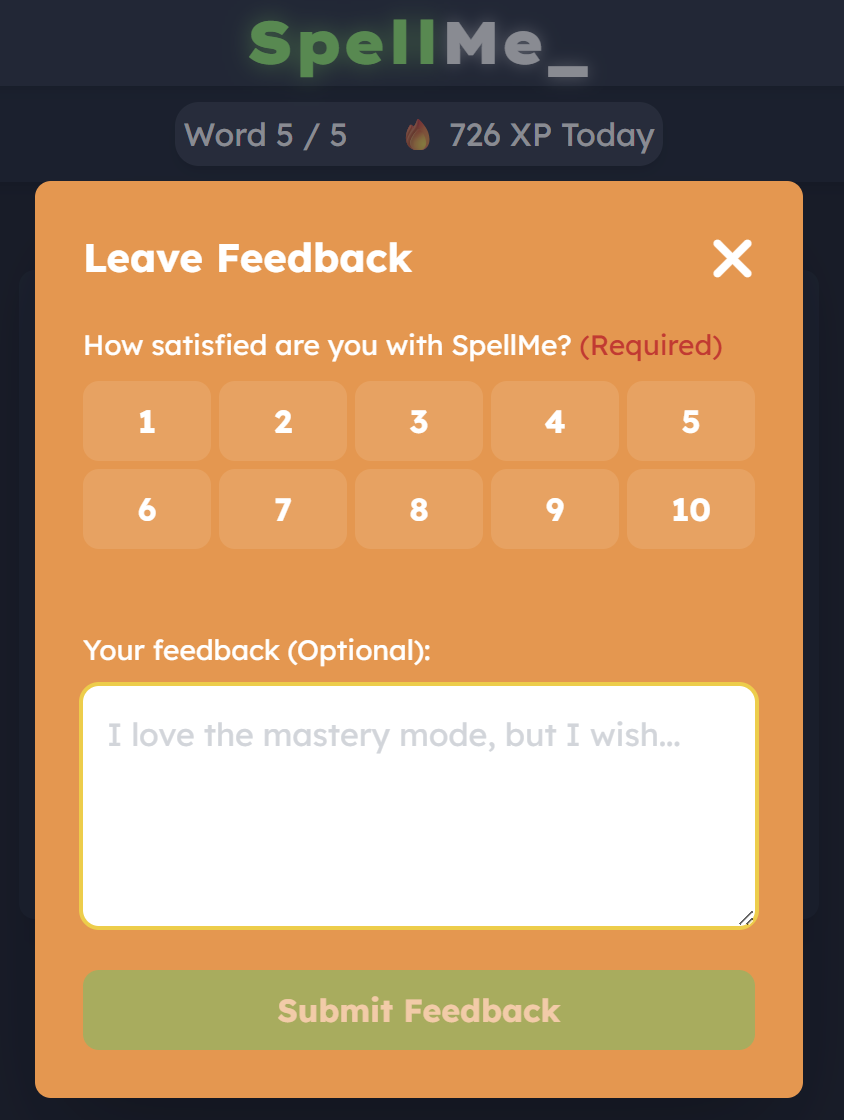
Building edtech tools isn't easy. One of the most difficult things is finding out from the end-user, what words and what doesn't. I guess it's the same for any type of tool, edtech or not, but when learning is involved, it seems more important to know the results. This is why we have created another method of contact directly from the SpellMe webapp itself. The other two methods are via email and via the contact form on the blog. But directly in the app, hopefully, allows for more convenient communication, not having to leave the app.
The feedback form can be accessed by clicking on the orange button on the right of the screen. We ask that you add a score out of 10 to let us know your general impressions of SpellMe. Logged in users automatically have their comments linked to their accounts to make it easier for use to respond to any issues. Guest users, have the option of adding their email address as well as their comment.
Any and every piece of feedback is vital for helping to improve the app, and you can leave feedback anonymously if you like by making sure you are logged out and by not including your email address. That makes it difficult to get back to you if you need a response, but if you don't and you feel more comfortable expressing yourself that way, then that's totally fine. Our aim is to make the best literacy app we can, and to help others do the same. So, let us know how we can make it better for you or your spellers.
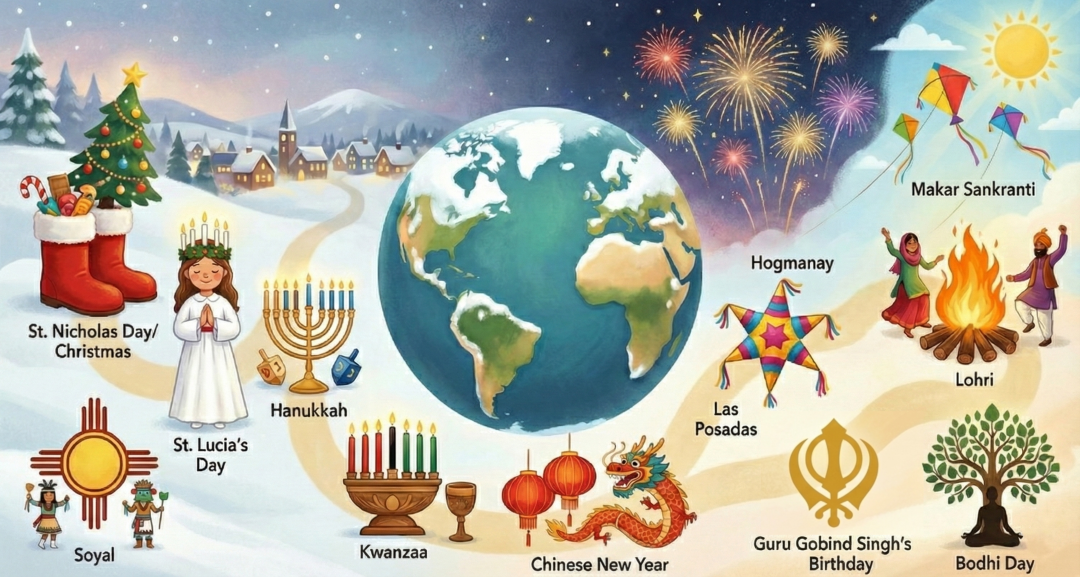
We are now well into the festive season with many people already enjoying a well-earned holiday. I have always been fascinated with the many occasions that different cultures choose to celebrate, as it gives insight into the cultures themselves. What is also fascinating is the similarity between the words and themes that are present within each celebration. It is such a learning experience and I wanted to use SpellMe as an avenue for learning about these cultural experiences. So, I have introduced 13 new sets of word lists based on 13 of the different celebrations that are happening around the world right now. Each set has 7 different word lists at levels K through to 6 (representing Kindergarten to Grade 6), and all are live right now on SpellMe via the freshly decorated SpellMe word lists button.

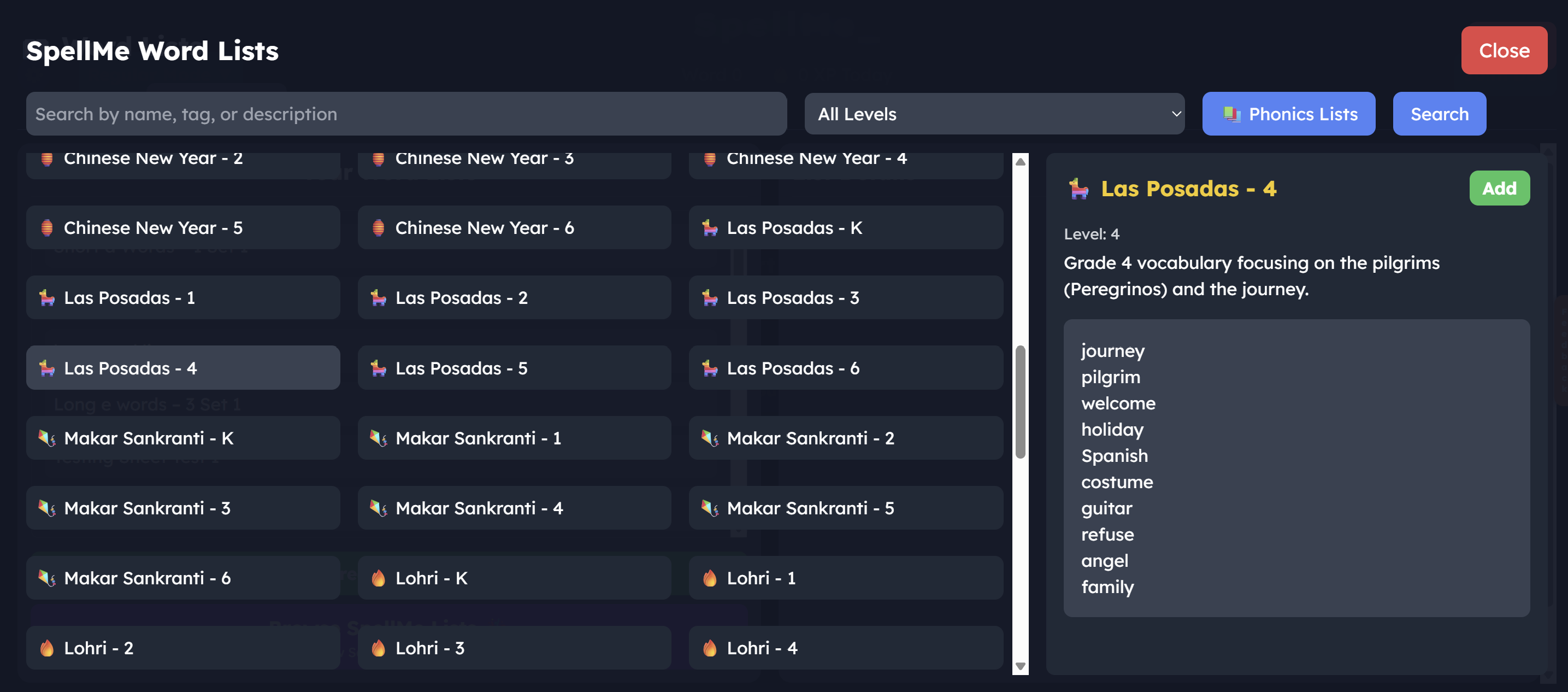
Below is a summary of the different festivities, organised by date, stating what the celebration is, who celebrates it and when.
Early December
👞 St. Nicholas Day
What it is: A favorite for children in Europe, this day honors the saint known for secret gift-giving. Kids leave their shoes out the night before to be filled with treats, coins, or small gifts.
Culture/Religion: Christian / European (Popular in Germany, Netherlands, Belgium).
When: December 6th.
🪷 Bodhi Day
What it is: A peaceful commemoration of the day Siddhartha Gautama (the Buddha) attained enlightenment while sitting under the Bodhi tree. It is observed with meditation, reading sutras, and eating a traditional meal of rice and milk.
Culture/Religion: Buddhist.
When: December 8th (Japan/Secular calendar) or varying lunar dates.
👸 St. Lucia’s Day
What it is: A festival of lights that brightens the dark Nordic winter. It features a procession led by a girl wearing a crown of candles, symbolizing light in the darkness, and eating saffron buns.
Culture/Religion: Scandinavian (Sweden, Norway, Denmark) / Christian.
When: December 13th.
Mid-to-Late December
🪅 Las Posadas
What it is: A nine-day celebration reenacting Mary and Joseph’s search for shelter (posada) in Bethlehem. Each night features processions, songs, and parties with piñatas.
Culture/Religion: Mexican / Latin American / Catholic.
When: December 16th – 24th.
☀️ Soyal
What it is: The winter solstice ceremony of the Hopi people. It marks the time when the Kachinas (spirits) come down from the mountains to help bring the sun back to the world.
Culture/Religion: Hopi (Native American).
When: Winter Solstice (around December 21st).
🕎 Hanukkah
What it is: The Jewish "Festival of Lights," celebrating the miracle where oil meant to last one day burned for eight. Families light the menorah, play dreidel, and eat fried foods like latkes.
Culture/Religion: Jewish.
When: Eight days (varies based on Hebrew calendar, usually Nov/Dec).
🎄 Christmas
What it is: The celebration of the birth of Jesus Christ, as well as a secular season of giving. Traditions include decorating trees, exchanging gifts, and family feasts.
Culture/Religion: Christian / Global Secular.
When: December 25th.
🕯️ Kwanzaa
What it is: A celebration of African American culture and heritage. It focuses on seven core principles (Nguzo Saba), including unity and creativity, ending with a feast and gift exchange.
Culture/Religion: African American / Pan-African.
When: December 26th – January 1st.
🥳 Hogmanay
What it is: The distinct Scottish celebration of New Year’s Eve. Famous for massive street parties, fire festivals, and "first-footing"—the tradition of being the first person to cross a friend’s threshold after midnight for good luck.
Culture/Religion: Scottish.
When: December 31st.
January & February
🦁 Guru Gobind Singh’s Birthday
What it is: A celebration of the birth of the tenth Sikh Guru, a warrior-poet who founded the Khalsa brotherhood. It is marked by parades (Nagar Kirtan) and community service.
Culture/Religion: Sikh.
When: Varies (typically January 5th or based on the lunar calendar).
🔥 Lohri
What it is: A popular winter folk festival that marks the passing of the winter solstice. It is celebrated by lighting bonfires, singing, dancing to drumbeats, and eating festive foods like sesame and jaggery.
Culture/Religion: Punjabi / North Indian.
When: January 13th.
🪁 Makar Sankranti
What it is: A major harvest festival marking the sun’s journey into Capricorn. It is famously celebrated by taking holy dips in rivers and filling the sky with thousands of kites.
Culture/Religion: Hindu / Indian.
When: January 14th.
🏮 Chinese New Year (Lunar New Year)
What it is: The most important holiday in Chinese culture, marking the start of the lunar year. It involves family reunions, red envelopes for luck, dragon dances, and the Lantern Festival.
Culture/Religion: Chinese / East Asian.
When: Varies (between January 21st and February 20th).
During this festive period, I will be highlighting a different festive list each day as "Word List of the Day" on the SpellMe landing page, and will be sharing it on social media. I will be adding new lists continually next year as the year goes on. The word lists are available for registered users, including those with free accounts. So check them out and get your child or students to learn about their festivities or others.
Wishing you all happiness and good fortune during this period, whatever you celebrate and wherever you are.
Image Source - Gemini
I recently wrote an article on my main blog 21st Century Chalk Called Your Neurodivergent Child Isn’t Broken — They’re Just Running MacOS in a Windows World. The article reframed neurodivergence as a difference and not just a disability. It did not make light of the real difficulties that people with ADHD and dyslexia had, but wrote about how research suggested it was better to see those difficulties through a different lens. In the article, I mentioned
"...reading and writing are not natural human actions..."
This is backed up by a recent video by the BBC 'How reading changes the way your brain works'. The video discusses the different parts of the brain that need to come together to decode words, sounds and meaning, and how the efficiency of those different parts working together directly reflect the difficulty someone has in literacy. The most interesting thing mentioned in the video was the difference in dyslexia between different cultures and writing forms, specifically Chinese and English. Essentially, someone with dyslexia in English would not have the same difficulties in Chinese. In this article, I want to talk about this and how this is related to some key SpellMe features and solutions.
1. Structure the Unnatural

The point: The video mentions that reading was unnatural, requiring different parts of the brain (not usually associated with each other) to work together. This is why reading and spelling is difficult to just 'get', and many would need an explicit and systematic approach to learning it.
The solution: Structured literacy, the basis of the SpellMe word lists, can be used to help with this issue by forming a scaffold round the learning, that students can build upon. It explicitly teaches phonology and sound-symbol mapping, rather than leaving the learner to guess. For more on this you can read the previous post The Science Behind SpellMe - Part 1: Word Lists.
2. Let Construction Lead to Understanding
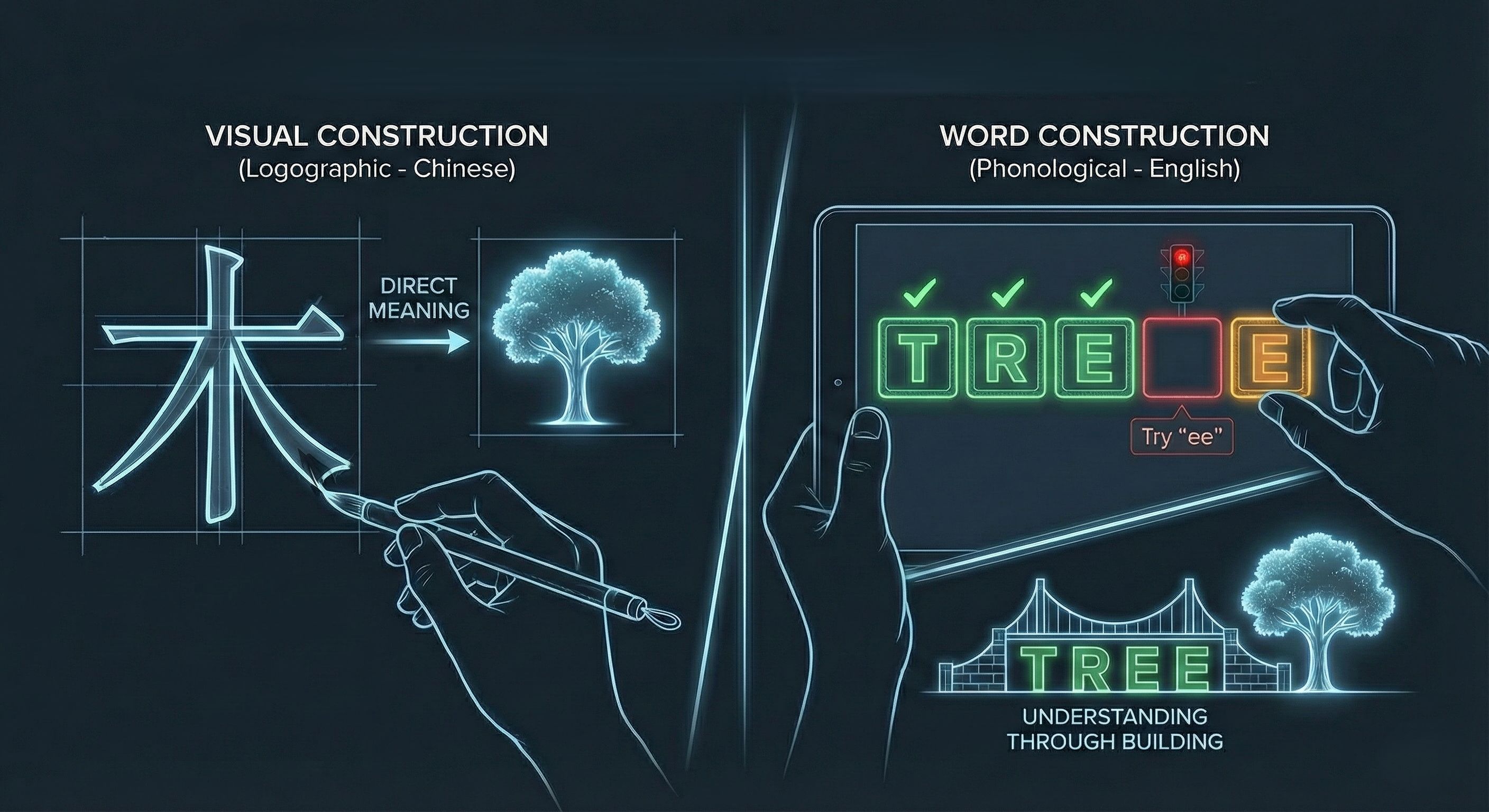
The point: The video mentions that Chinese is a logographic language (where symbols, or logograms, represent entire words, rather than sounds or syllables). Students with a deficit in phonological awareness (hearing the sounds in words), would struggle in English. But that same student might survive or thrive in Chinese because they can rely on Visual Memory to recognize the characters directly, bypassing the phonological "glitch."
The solution: The process of constructing the word in English, just like drawing the logograms in Chinese can help. Associating the meanings with constructing the word helps with understanding. Writing is the best way to help solidify reading and spelling knowledge and should be used in conjunction with SpellMe wherever possible. However, SpellMe also uses the process of constructing words through the traffic light hint system - showing the speller where they went wrong - and the leveled gaps feature. This mechanism speeds up the process of learning through failure and repetition, which leads me into the final point.
3. Nurture the Neuroplasticity & The "Gamified" Fail

The Point: The video mentions neuroplasticity, or how the brain changes depending on the input. It is not fixed so can rewire itself given enough repetition and error correction. The problem is, a learner needs a welcoming and nurturing environment in order for this to happen. If the emotional cost of error is too high (e.g. like feeling shame), the brain disengages, and plasticity stops.
Solution: SpellMe actively rewards failed attempts, because we understand that failure is the stepping stone to success. By gamifying the repetition and removing the shame of getting it wrong, the app keeps the brain in a "plastic" state (willing to try again), which is a way for new neural circuits described in the video to grow. Those failed attempts seen in a positive constructive light help the brain develop those learning links.
Conclusion
This video highlighted and gave further evidence for the fact that dyslexia can be seen as a difference confined to cultural characteristics, not just a learning disability. This helps us see it through a different lens, understanding it in a different way and providing innovative solutions to suit. If you are interested in finding out more, you can check out the video and read the research articles below, then share your thoughts.
Sources:
- Biological Abnormality of Impaired Reading Is Constrained by Culture
- How reading changes the way your brain works - BBC World Service (Youtube)
- Prevalence and Associated Risk Factors of Dyslexic Children in a Middle-Sized City of China: A Cross-Sectional Study
- A case study of an English-Japanese bilingual with monolingual dyslexia
- Images by Gemini